In 1969 Davis accepted a position as assistant professor in the philosophy department at the University of California, Los Angeles(UCLA) declining positions at Princeton University, in New Jersey, and Swarthmore College, in Pennsylvania. Popular with students, her colleagues in the philosophy department, and other UCLA faculty, Davis carefully avoided any talk of her political affiliations and organizing work.
In June 1969 the Daily Bruin printed an article written by underground FBI agent William Divale stating that Davis was a Communist. Questioned by school administrators Davis responded that she believed the question to be impermissible on the grounds of both constitutional freedom and academic policy though she also acknowledged her Communist affiliation.
The California Board of Regents, led by then-governor Ronald Reagan, demanded that Davis be fired, and relying on a 30-year-old university regulation forbidding Communists on the faculty, the board complied. The controversy engendered widespread support for Davis including 1000 of her fellow professors at UCLA as well as the American Association of University Professors . Finally in October California Superior Court Judge Jerry Pacht ruled the regents could not fire Davis solely because of her affiliations. Davis resumed her post to packed classes, national acclaim, academic support as well as daily death threats. Davis armed herself and enlisted bodyguards in response to the threats.
As the University monitored her classes Davis became the Los Angeles chair of the Soledad Brothers Defense Committee, set up to gather support for three black prisoners at Soledad State Prison accused of killing a prison guard (a decision that led to her termination from UCLA). Among the accused convicts was writer and political activist George Jackson. Many people believed the accusations were politically motivated.
On August 7th Jonathan Jackson, brother to George, stormed the Marin County Courthouse during the trial of BPP member James Mclain intending to free Mclain and kidnap presiding Judge Harold Haley to negotiate George Jackson's release. A shootout erupted outside the courthouse leaving four dead including Jonathan Jackson and Judge Haley.
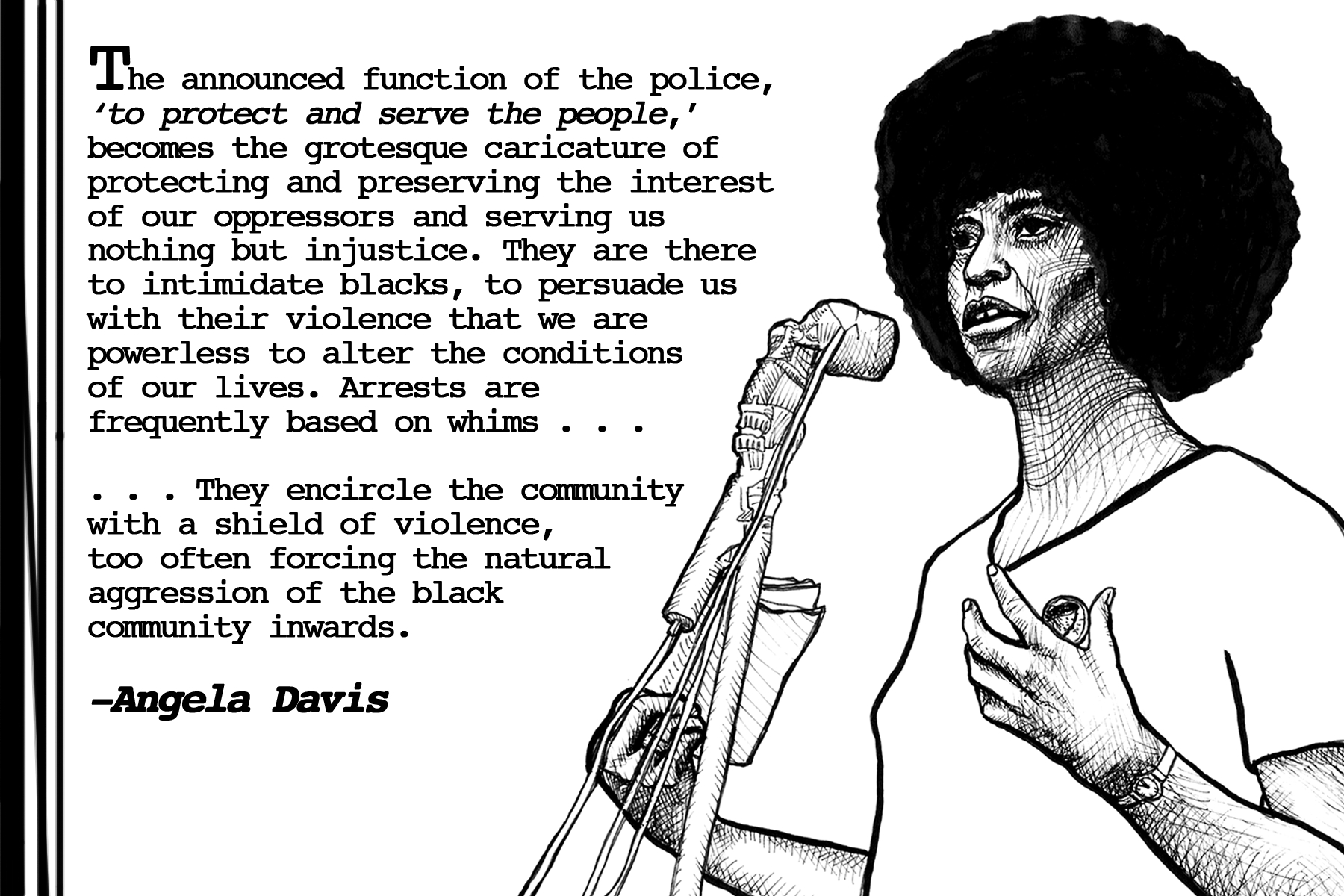
In the ensuing days the police sought to implicate Davis in the attack. As thousands gathered at Jonathan Jackson's funeral she went underground. On August 15, 1969, warrants were issued for her arrest, charging her as an accomplice to conspiracy, kidnapping, and homicide . Four days after the initial warrant FBI director J. Edgar Hoover made Davis the third woman to appear on the FBI's Ten Most Wanted List. As support for Davis grew, police and FBI personnel descended on black communities throughout Los Angeles, the Bay Area, Canada and Birmingham, scouring neighborhoods and detaining hundreds of black women that fit Davis's description. On October 13, 1970 Davis was apprehended in New York City and taken to that city's Women's Detention Center.
Initially held in solitary confinement, Davis, with the help of her legal team obtained a federal court order releasing her from segregation. Once in the general population she mobilized her fellow inmates, in particular, helping to initiate a bail program for indigent prisoners. In January, 1971 Davis was extradited to California and arraigned at the Marin County Court where she declared her innocence.
Friends, family, and fellow activists organized thousands of people into The National United Committee to Free Angela Davis and all Political Prisoners. By February 1971 more than 200 local committees in the United States, and 67 in foreign countries worked to liberate Davis from prison. Hundreds of thousands of support letters were sent, plays were performed, and rallies organized all over the world. Many entertainment figures supported her release including The Rolling Stones with the song “Sweet Black Angel” and Jon Lennon and Yoko Ono with their song “Angela”.
Represented by Leo Branton, Jr Davis was tried, and the all-white jury returned a verdict of not guilty. The fact that she owned the guns used in the crime was judged not sufficient to establish her responsibility for the plot and no evidence could be found that she had supplied Jackson with the weapons.
After this victory Davis continued her academic work becoming professor of Ethnic Studies at the San Francisco State University from 1980–84, professor in the History of Consciousness and the Feminist Studies Departments at the University of California, Santa Cruz from 1991 to 2008 and is now Distinguished Professor Emerita at Santa Cruz. Davis was a Distinguished Visiting Professor at Syracuse University in Spring 1992 and October 2010. In 2014, Davis returned to UCLA as a Regents’ Lecturer.
For over fifty years Angela Davis has fearlessly upheld the cause of black liberation, gender equity, and end to slavery in the form of the prison industrial complex. In her capacity as a philosopher, educator, and organizer she has influenced multiple generations of men and women campaigning for universal equal rights.