"Jill Scott was born at the right time to be accepted as is."
Dawn Wolf, Keeper of Stories
9.08.12
 |
singer & actress
JILL SCOT
|
 |
Kandi Burruss is a composer of note,
and a reality star
The Real Housewives of Atlanta
2010 |
"Don't know why Kandi Burruss left the show, but I am glad she did. For me, it was disappointing she stooped to the level of the show's maturity level, and joined the cast. Maybe she needed the money. Her call. I trust her deeper sense of who she is, and why she is here is in command creating order for her role in this lifetime upon the Earth, our Mother." -
Gregory E. Woods
 |
| Iyanla Vanzant sitting with Oprah !!!! |
"
Look at her! I was always captivated by Iyanla Vanzant. She has long set up shop here in Washington DC, and is part of our African spiritual community. There are eleven African houses here. Six of them are Yoruba. She is respected amongst all of them and a lot of Black Christians accept her, and take counsel with her. I have never done ceremony with her. I would if Spirit designed it that way.
Iyanla Vanzant's powers are read. They register, with most of the men here I know, and know of, when reading her books or watching her on Oprah. I don't know many Black men who watched Oprah regularly, but the Priestess' appearances were worth watching, and paying strict and close attention to. It was partly due to the air she carried. Her air, and her words, and demeanor said, "I am a single mom!" That posture created an immediate response within men raised by women like her. It was in their tone of voice, and it was a response men, like me who were raised in a traditional household, did not connect with in like manner. We had interesting and conflicting testimonies about her advise when it came from the dominant posture of her role playing on the Oprah show. I was used to a dominant masculinity as the head of the house. In discussions we had to admit that her sense of masculinity had a crippling effect upon a boy and a man, and then an insight into her as a wife or a lover colored her affirming, and contradicted a point made!
One day I remember the raw emotions coming out of one cat defending her when she, in my estimation, weakened her husband on national TV the way she spoke about him in relation to money, and income. My man was speaking in his 'little boy' voice defending her statement. He was used to the tone of voice that was demeaning and supportive, or sounded supportive and affirming, but tore down esteem. It angered me, and ticked the rest of us off! Most of us knew she'd killed her marriage unintentionally in that moment. That show took us and others into discussions about masculinity and our manhood, and how a man is shaped by a female dominated household and how a man is shaped in a man/woman dominated household. Feminine masculinity is often accepted by cats defined by their mothers, but that is not a hard and fast rule just an observable factor living within a lot of men.
Along with those, and other things the high Priestess sparked many of us who thought she was so fine, and perfectly made. We couldn't take our eyes off her, and dreaded the inevitable commercial breaks, and loved the long camera shots to look at her body. She was so perfectly made. When she wore colors, and the colors flowed when she talked and walked with that short hair cut, she was divine. We sparkled as her eyes sparkled. The cats in my circle at the time, respected Oprah, but we'd seen her on her Baltimore show, and we were not drawn to her because her introspective work did not embolden a man's spirit. It set us on edge.
The Priestess was Yoruba. West African spirituality is Earth centered. It has a worldview deeply connected to the whole gamut of human emotions, and bodies of being. It is knowledge based. Wholeness, and coolness within elders are developed and earned qualities of being. Those qualities compel us to leave gifts with them before we ask for permission to take advice from them. The need for dominance is not a part of the lexicon of Yoruba, or Akan, or Vodoun. How the Priestess carried these sensibilities and teachings within her African American soul and body was the teacher we needed. We could accept any of her faults because she sought wholeness. When we say she is fine these are the elements incorporated into the compliment. - Gregory E. Woods,
Keeper of Stories 9.08.12
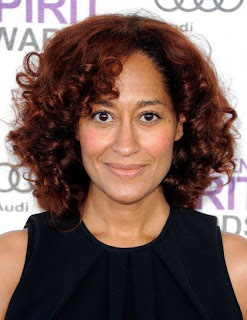 |
actress Tracee Ellis Ross
2012 |
"
Never wondered about how Tracee Ellis Ross maintains her hair. I was intrigued by how she maintained her pace, her energies and the birth legacy of her family, and how she did not develop into a push over in her field of endeavor." - Dawn Wolf, Keeper of Stories
9.8.12


